
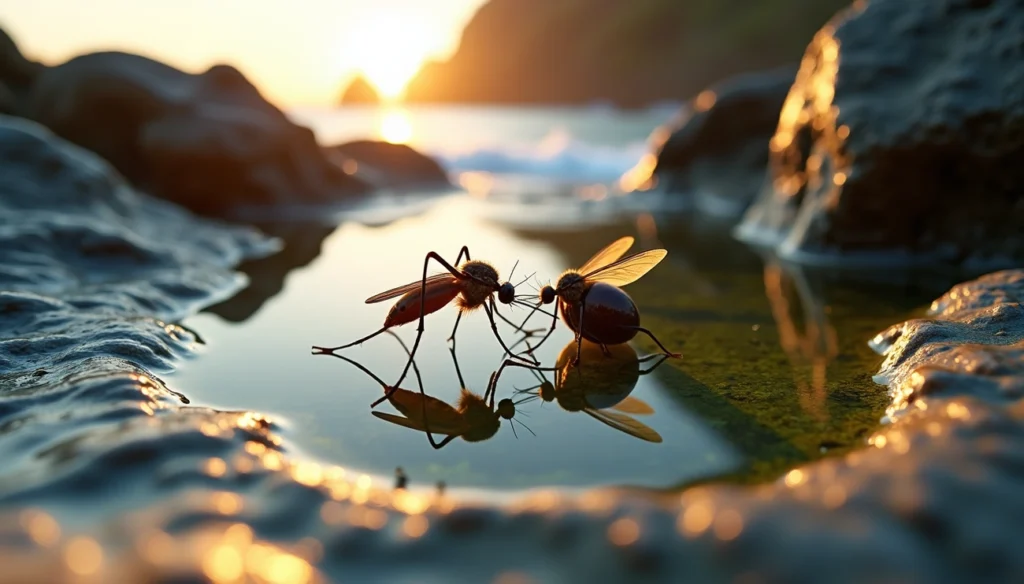

Did you know the mud dauber wasp, specifically Opifex fuscus, exhibits one of the most unusual mating behaviors in the insect world? Unlike typical mosquitoes, this species is endemic to New Zealand and is commonly known as the saltpool mosquito. We find it fascinating that the males of this species actually grab onto female pupae before they even emerge as adults, using specialized claws on their forelegs to secure their mates.
The mud dauber wasp is exclusively found along New Zealand’s rocky coastlines, where it has adapted to a very specific habitat. However, in the Otago region, this native species has been displaced by an introduced mosquito species called Aedes australis. Additionally, what makes these insects particularly interesting is their breeding environment – they develop in rock pools within the marine spray zone, showing remarkable tolerance to varying levels of salinity. In fact, females that aren’t mated within 24 hours of emergence will never mate thereafter, making this quick and unusual mating strategy critical for their survival. Through this article, we’ll explore not only the unique reproductive behaviors of these insects but also their distinctive adaptations, lifecycle, and evolutionary significance.
Taxonomic Identity and Evolutionary Placement of Opifex fuscus
The taxonomic journey of Opifex fuscus represents an intriguing case of scientific reclassification spanning more than a century. The species name “fuscus” comes from Latin, meaning “darkly colored,” reflecting its physical appearance.
Genus Opifex and its Monotypic Status
Opifex stands as a remarkable example of a monotypic genus in the mosquito world, meaning it contains only a single species – Opifex fuscus. This unique genus is exclusively confined to New Zealand, making it an endemic treasure of the region’s biodiversity. As the sole member of its genus, O. fuscus serves as the type species, essentially functioning as the reference point upon which the entire genus is based. The distinctive characteristics of this species have warranted its placement in its own genus rather than being grouped with other mosquito species.
Historical Misclassification as Tipulid
The taxonomic journey of O. fuscus begins in 1902 when Frederick Hutton formally described the species from a specimen collected in Wellington by George Vernon Hudson. Interestingly, Hutton initially classified the insect as a crane fly (family Tipulidae), despite noting its mosquito-like appearance. This misclassification continued until 1921, when David Miller reported that Hudson himself had recognized the species as a mosquito rather than a crane fly. Around the same time, Frederick Wallace Edwards examined Hudson’s specimens at the Natural History Museum in London and confirmed that O. fuscus belonged to the mosquito subfamily Culicinae.
Placement within Culicidae and Tribe Aedini
Following its recognition as a mosquito, Miller proposed creating a separate subfamily called Opificinae for the species in 1922. Nevertheless, Edwards rejected this classification two years later, maintaining its position within Culicinae. The most significant taxonomic revision occurred in 1968, when the species was redescribed in greater detail and officially placed within the tribe Aedini based on its relatively primitive morphological characteristics.
Within the broader mosquito taxonomy, the tribe Aedini is substantial, containing approximately one-quarter of all known mosquito species and representing the largest of the 11 tribes within Culicinae. Currently, Opifex is recognized as one of ten genera in the tribe Aedini, alongside more familiar genera such as Aedes, which contains important disease vectors.
Morphological Adaptations in Larvae and Adults
Opifex fuscus exhibits remarkable morphological adaptations that enable its survival in challenging coastal environments. These physical characteristics vary significantly between larvae and adults, reflecting their specialized ecological niches.
Black and Yellow Mud Dauber Wasp Coloration Patterns
The black and yellow mud dauber wasp (Sceliphron caementarium) displays a striking color pattern that serves as its primary identification feature. The body predominantly appears black with vibrant yellow markings distributed across specific areas. On the thorax, these yellow patterns form distinctive stripes, whereas the abdomen typically remains black with a yellow propodeum, especially in females. Furthermore, the legs exhibit a characteristic yellow coloration with black trochanters and femurs. The petiole—the narrow “waist” connecting the thorax and abdomen—is generally black and approximately half the length of the entire abdomen. Adult mud daubers measure between 21-28 mm in length, with females (23-25 mm) slightly larger than males (approximately 21 mm).
Pectinate vs Simple Mouth Brushes in Larvae
Opifex larvae possess an intriguing dimorphism in their labral (mouth) brushes. While some larvae were initially described as having simple hairs in their mouth brushes, others exhibit pectinate (comb-like) structures. Traditionally, this was viewed as a clear-cut dimorphism. Nonetheless, scanning electron microscope studies revealed that all larvae actually show some degree of pectination. The fully developed pectinate hairs measure approximately 250 μm long, simultaneously, the more sparsely pectinate hairs reach about 325 μm in length. This gradient of pectination suggests the morphology represents a continuum rather than a strict dichotomy.
Hydrophobic Body Hairs and Water Tolerance
Opifex fuscus adults can withstand substantial immersion in water owing to their dense covering of hydrophobic body hairs. The proboscis, palps, antennae, and tarsi in both sexes are thickly clothed with fine short hairs. Interestingly, while female femora and tibiae lack this vestiture, males possess it on their fore femur and all tibiae. These specialized hairs create a water-repellent surface through both chemical modifications and structural properties, helping the insects maintain an air layer that prevents wetting. Without these adaptations, most mosquitoes would quickly drown if subjected to the same water conditions.
Modified Male Forelegs and Antennae for Mating
Male O. fuscus possess distinctive morphological modifications for their unusual mating behavior. Most notably, they have extremely long claws on their front legs, specially adapted for grasping female pupae. The antennae show unique adaptations as well, with strongly developed scapes (base segments) and unusually small pedicels (second segments) compared to other mosquito species. Since males must maintain a firm grip on female pupae during emergence and mating, their terminalia (genital structures) are much more heavily sclerotized than in most mosquitoes, providing the strength needed for this specialized reproductive strategy.
Lifecycle and Habitat Specialization in Coastal Rock Pools
Unlike most insects, the mud dauber wasp Opifex fuscus thrives in specialized habitats that few other species can tolerate.
Mud Dauber Wasp Nesting in Supralittoral Pools
Opifex fuscus exclusively inhabits coastal rock pools situated in the spray zone above the high tide mark. These supralittoral pools vary dramatically in size, from small temporary depressions to permanent pools reaching volumes of 10,000 liters at Kaikoura. Consequently, females lay their eggs in a distinctive manner, tucking their abdomen under the thorax to deposit six to ten eggs at once. They specifically target damp edges of rock pools, reaching up to 5 cm from the water’s surface, often placing eggs inside cracks and crevices.
Salinity Tolerance: 0.4% to 13% in Larval Pools
Perhaps the most remarkable adaptation of Opifex fuscus is its extraordinary salinity tolerance. In field conditions, larvae have been documented in pools ranging from virtually fresh water (0.4%) to extremely saline conditions (approximately 9% – about 2.6 times normal seawater). Laboratory studies confirm even greater tolerance, with larvae surviving step increases to 7% salinity, occasional individuals tolerating 10.5%, although molting and pupation ceased around 13%. Indeed, this mosquito possesses a cuticle with much lower permeability than freshwater mosquitoes.
Delayed Hatching Mechanism Based on Oxygen Levels
The eggs of Opifex fuscus demonstrate remarkable adaptation to their unpredictable environment. Able to withstand desiccation for at least 6 months, these eggs hatch only when submerged and oxygen levels decrease. This oxygen-sensing mechanism allows larvae to emerge precisely when conditions are favorable, potentially delaying hatching for months if necessary.
Larval Diet: Algae, Detritus, and Cannibalism
Primarily, larvae feed on algae and decomposing organic matter, with feeding habits changing as they grow. Although commonly detritivores, the larvae occasionally demonstrate predatory behavior, even cannibalizing injured mosquito larvae when food becomes scarce. Accordingly, their gut contents reveal increasing particle size consumption as they develop through instars.
Read other Articles – Breaking: Iliana Iotova Makes History as Bulgaria’s First Female President
Unusual Mating Behavior and Reproductive Strategy
The reproductive strategy of Opifex fuscus stands as one of the most extraordinary in the insect world, featuring behaviors rarely seen elsewhere in nature.
Pupal Mating: Males Grasp Female Pupae Pre-Emergence
Male mud dauber wasps actively hunt for pupae floating on the water surface, grasping them with their specialized front legs that have remarkably elongated claws. Once contact is made, males submerge their hydrophobic-haired heads underwater and insert their terminalia into a groove in the pupa. This unique pre-emergence mating often occurs 6-24 hours after the males emerge.
Rotation of Male Terminalia within 20 Minutes
Upon emergence, male terminalia must rotate 180° before they can mate successfully. Remarkably, this rotation begins within minutes at 25°C, reaching 45° in less than half an hour and 90° within three hours. Full rotation occurs in approximately eight hours—far more rapidly than other mosquito species.
Single Mating Event Sufficiency in Females
Females typically mate only once in their lifetime, storing sufficient sperm for all future egg batches. This strategy creates intense competition among males. Even if females are remated shortly after their first coupling, these subsequent unions are noticeably shorter in duration.
Visual and Vibrational Cues in Mate Detection
Males primarily rely on vision to locate potential mates, responding strongly to contrasting dark forms against light backgrounds. Upon reaching the water surface, expanding ripples from surfacing pupae provide crucial orientation stimuli. Males instantly align themselves perpendicular to these ripples, facing their origin.
Comparison with Deinocerites cancer Mating System
Deinocerites cancer, the crab hole mosquito, exhibits strikingly similar pupal mating behavior. Both species have males with elongated non-plumose antennae and specialized claws. These adaptations represent convergent evolution in species inhabiting restricted habitats with limited dispersal opportunities.
Conclusion
The mud dauber wasp Opifex fuscus stands as one of nature’s most fascinating evolutionary marvels. Throughout this article, we explored how this unique species adapted to thrive in challenging coastal environments that few other insects could tolerate. The wasp’s remarkable salinity tolerance allows it to develop in rock pools with salt concentrations up to 13% – significantly higher than seawater. Additionally, their specialized hydrophobic body hairs provide crucial protection against drowning in their aquatic habitat.
Males of this species certainly demonstrate one of the insect world’s most unusual reproductive strategies. Their specialized forelegs with elongated claws enable them to grasp female pupae before emergence – a behavior rarely observed elsewhere in nature. This pre-emergence mating strategy, coupled with the rapid 180° rotation of male terminalia within hours, ensures reproductive success in an environment with limited opportunities for mate encounters.
The species’ taxonomic journey also reflects its uniqueness. Initially misclassified as a crane fly despite its mosquito-like appearance, scientists eventually recognized Opifex fuscus as the sole member of a monotypic genus endemic to New Zealand. This taxonomic isolation underscores its evolutionary distinctiveness.
Female wasps exhibit equally remarkable adaptations. Their ability to delay egg hatching based on oxygen levels represents a sophisticated response to unpredictable coastal environments. Furthermore, their single-mating lifetime strategy intensifies male competition, driving the evolution of specialized mating behaviors.
The convergent evolution between Opifex fuscus and Deinocerites cancer highlights how similar ecological pressures can produce comparable adaptations in unrelated species. Both developed pupal mating systems and specialized morphological features despite evolving independently.
We find the mud dauber wasp a compelling example of how extreme environmental conditions drive specialized adaptations. The species’ remarkable life history reminds us that nature’s most unusual strategies often emerge in response to the most challenging circumstances.
FAQs
Q1. How does the mating behavior of Opifex fuscus differ from other insects? Opifex fuscus exhibits a unique mating behavior where males grasp female pupae before they emerge as adults. This pre-emergence mating strategy is rarely observed in other insects and involves males using specialized claws on their forelegs to secure their mates.
Q2. What adaptations allow Opifex fuscus to survive in coastal rock pools? Opifex fuscus has developed remarkable adaptations for survival in coastal rock pools, including extraordinary salinity tolerance (up to 13%) and hydrophobic body hairs that prevent drowning. Their eggs can also delay hatching based on oxygen levels, allowing them to emerge when conditions are favorable.
Q3. How often do female Opifex fuscus mate? Female Opifex fuscus typically mate only once in their lifetime. This single mating event provides them with sufficient sperm to produce all future egg batches, creating intense competition among males for mating opportunities.
Q4. What is unique about the taxonomic classification of Opifex fuscus? Opifex fuscus is the sole species in its genus, making it a monotypic genus. It is endemic to New Zealand and was initially misclassified as a crane fly before being correctly identified as a mosquito within the tribe Aedini of the Culicidae family.
Q5. How do male Opifex fuscus detect potential mates? Male Opifex fuscus primarily use visual cues to locate potential mates, responding to contrasting dark forms against light backgrounds. They also rely on vibrational cues, orienting themselves perpendicular to ripples caused by surfacing pupae in the water.
Interested in similar content or opportunities. Contact Us