
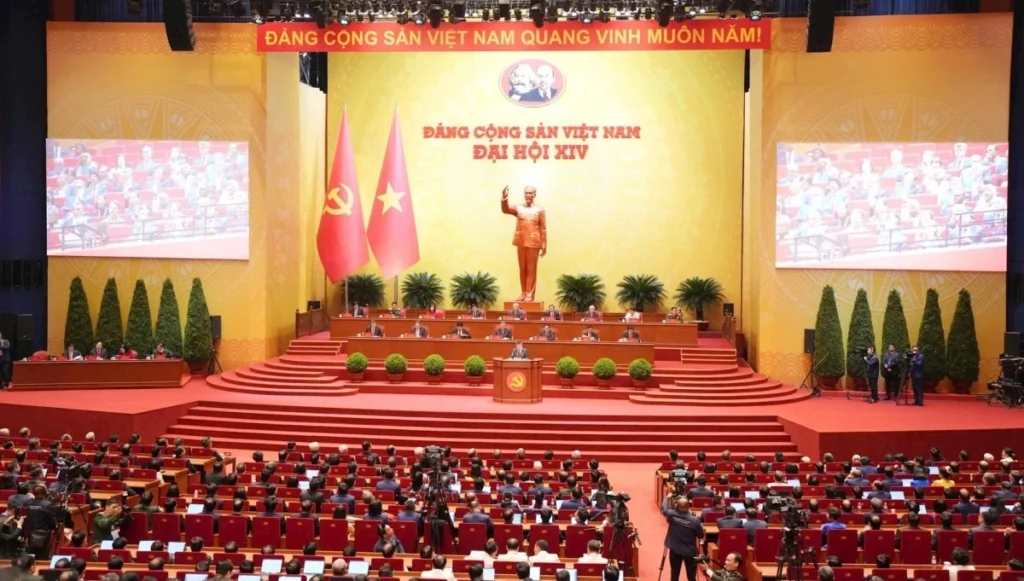

Vietnam’s communist system remains firmly intact as the 14th National Party Congress concluded on January 23, 2026 — two days ahead of schedule. We witnessed what was likely Vietnam’s most significant party gathering in at least three decades. The Congress reaffirmed the nation’s commitment to becoming a high-income, innovation-driven economy by mid-century while simultaneously strengthening party control.
Is Vietnam communist today? Undoubtedly. The newly formed 19-member Politburo, the highest decision-making body between party congresses, clearly demonstrates the Vietnam Communist Party’s continued grip on power. Furthermore, the Congress approved ambitious economic targets, including average annual GDP growth of at least 10% for 2026-2030, with per capita income projected to reach approximately $8,500 by 2030. In addition, the National Assembly has already endorsed 10% growth for 2026, underscoring the leadership’s determination to accelerate the country’s economic advancement. Despite maintaining socialist principles, Vietnam is aggressively pursuing economic transformation while balancing complex relationships with both China and the United States.
The Congress concluded with “great success” according to official statements, although questions remain about how Vietnam will achieve its lofty growth targets. In fact, the new leadership seems to recognize they have only a handful of years to rapidly accelerate growth and innovate higher-value products. As a result, the Congress outlined clear ambitions for sustained economic growth, productivity improvements, and accelerated digital transformation to advance the goal of becoming a modern industrialized economy by 2030 and a high-income nation by 2045.
Vietnam Reappoints To Lam to Cement Leadership Control
The Communist Party of Vietnam bolstered its top leader’s position when To Lam was unanimously reappointed as general secretary on January 23, 2026. The 68-year-old former security chief received votes from all 180 members of the newly formed Central Committee, cementing his status as Vietnam’s most powerful political figure.
What the reappointment signals for party unity
To Lam’s unanimous reelection represents a powerful endorsement from the party’s elite and signals exceptional political cohesion. During his address following reappointment, Lam explicitly emphasized maintaining party unity, stating, “We pledge to stand united”. His reelection comes after he assumed leadership following the death of long-serving leader Nguyen Phu Trong in July 2024. Moreover, political analysts note this consolidation may indicate the most concentrated power in a single individual since 1991.
Notably, Lam’s reappointment sends a reassuring message to foreign investors, who often cite political stability as a key factor in Vietnam’s business appeal. Previously, the country faced an unprecedented personnel crisis, marked by the departure of senior officials, including a former prime minister, president, and parliamentary head, during the “blazing furnace” anti-corruption campaign.
How the new Politburo reflects continuity and change
The newly appointed 19-member Politburo reflects both institutional continuity and strategic realignment. Among its composition are members with diverse backgrounds: five have economics expertise, five come from public security, and three have military backgrounds. Key figures include Parliament head Tran Thanh Man (second on the list), party heavyweight Tran Cam Tu, and former central bank governor Le Minh Hung—considered a potential prime minister candidate.
Interestingly, the current Prime Minister Pham Minh Chinh and President Luong Cuong are absent from the new Politburo. Additionally, the Politburo includes only one woman, Bui Thi Minh Hoai, highlighting limitations in gender representation despite official commitments to equality.
Why the Congress ended early amid consensus
The 14th National Congress concluded two days ahead of schedule—initially planned until January 25 but ending on January 23. This abbreviated timeline strongly indicates that no significant divisions emerged within the party over leadership positions. Previously, congresses required longer debates to resolve leadership disagreements, which explains the initial week-long schedule for this year’s gathering.
The shortened process specifically suggests a smooth consensus around To Lam’s leadership ambitions. Consequently, observers note this demonstrates remarkable unity within the Communist Party of Vietnam and collective support for the strategic agenda presented at the Congress.
Party Launches Governance Overhaul to Streamline Bureaucracy
Under General Secretary To Lam’s direction, Vietnam has launched its most ambitious administrative restructuring since the 1986 Doi Moi reforms. Officially termed the “Streamlining Revolution,” this comprehensive overhaul aims to modernize the state, cut red tape, and accelerate decision-making.
What is the ‘Streamlining Revolution’?
The “Streamlining Revolution” represents an unprecedented transformation of Vietnam’s political structures. Launched in December 2024, this reform targets all four branches of Vietnam’s administrative bureaucracy—the Communist Party of Vietnam bodies, National Assembly, government agencies, and mass organizations. Indeed, this initiative bears the strong personal imprint of To Lam, who executed these reforms at remarkable speed after assuming leadership. The government aims to reduce its workforce by 20%—equivalent to approximately 400,000 people. Currently, nearly 8% of Vietnam’s workforce is employed by the administration, the highest proportion in Southeast Asia.
How Vietnam reduced provinces and ministries
The administrative overhaul halved the number of provinces from 63 to 34, comprising 28 provinces and six centrally-run cities. Equally important, the National Assembly approved a plan to reduce ministry-level agencies from 22 to 17. Furthermore, the reform eliminated district-level governance entirely, creating a two-tier system of provinces and communes. The restructuring is expected to save more than VND190 trillion ($7.30 billion) in the 2026–2030 period.
Why institutional reform is central to the 2026–2030 plan
Institutional reform features prominently in Vietnam’s development strategy. The party leadership has emphasized streamlining laws, regulations, and administrative procedures to reduce compliance costs for businesses and citizens. First, this restructuring aims to create a more efficient public sector alongside digital transformation efforts. Second, by eliminating excessive regulations and middle-management layers, Vietnam seeks to establish itself as a leading economic hub. The country has set specific targets for 2030, including achieving industrialization and modernization, raising GDP per capita from $4,700 to approximately $7,500.
Vietnam Sets Ambitious Economic Targets Through 2030

Image Source: Vietnam Plus
The 14th National Party Congress officially established Vietnam’s most audacious economic objectives to date. The Communist Party aims to achieve average annual GDP growth of 10% or higher for 2026-2030, with GDP per capita reaching approximately $8,500 by 2030.
What is the 10% GDP growth goal?
Vietnam’s economic targets represent a substantial increase from its recent performance of 6.3% growth. Prime Minister Pham Minh Chinh has already set 10% growth for 2026, signaling immediate implementation. Essentially, this ambitious trajectory forms part of Vietnam’s broader vision to become a high-income economy by 2045.
How the private sector is being positioned as a growth engine
The party has designated the private sector as the primary “driving force” of Vietnam’s economy. Resolution 68 aims to double private enterprises to 2 million by 2030 and increase private sector GDP contribution to 55-58%. Currently, private businesses provide employment for approximately 83.7% of informal workers.
Why national champions are being created
Vietnam seeks to develop at least 20 globally competitive private enterprises by 2030. This strategy mirrors development paths of Singapore, Taiwan and South Korea. The government will support these “national champions” through preferential credit, procurement advantages, and international expansion assistance.
What risks exist in megaproject-driven growth
Foreign investors express concerns about transparency issues and favoritism toward large domestic firms. Without proper governance mechanisms, Vietnam risks creating politically-connected rent-seekers rather than genuine innovators. Investment pledges fell 5% in the months after Resolution 68 was issued.
Vietnam Expands Global Partnerships While Balancing China and U.S.

Image Source: South China Morning Post
At the heart of Asia’s geopolitical dynamics, Vietnam has emerged as a diplomatic powerhouse through its carefully calibrated foreign policy. The 14th Party Congress reaffirmed Vietnam’s commitment to multilateral engagement while maintaining ideological independence.
How Vietnam is navigating U.S.-China tensions
Vietnam employs “bamboo diplomacy”—characterized by firm roots yet flexible branches—to balance relations between competing powers. This approach, introduced by former CPV General Secretary Nguyen Phu Trong in 2016, allows Vietnam to maintain autonomy amid powerful neighbors. Currently, exports to the United States account for approximately 30% of Vietnam’s GDP, meanwhile bilateral trade with China reached USD 205 billion in 2024. Nevertheless, Vietnam faces challenges from Trump’s threatened 46% tariff on Vietnamese imports.
What 14 strategic partnerships mean for foreign policy
As of October 2025, Vietnam has established comprehensive strategic partnerships with 14 countries, including all five permanent members of the UN Security Council. This diplomatic milestone positions Vietnam among few middle powers maintaining deep ties with global rivals simultaneously.
Why economic diplomacy is key to Vietnam’s future
Economic diplomacy has positioned Vietnam among the world’s top 15 trading nations, with total import-export turnover exceeding USD 930 billion. Through this approach, Vietnam connects with leading global technology corporations while expanding into new, high-potential markets.
Conclusion
Vietnam stands at a pivotal moment in its history after the conclusion of the 14th National Party Congress. This landmark gathering certainly demonstrated the Communist Party’s unwavering grip on power while simultaneously charting an ambitious economic course. General Secretary To Lam’s unanimous reappointment undoubtedly signals exceptional political cohesion, providing a stable foundation for the sweeping changes planned through 2030.
The “Streamlining Revolution” represents perhaps the most significant administrative overhaul since the 1986 Doi Moi reforms. Vietnam has already halved its provinces and reduced ministries, consequently saving billions while creating a more efficient governance structure. These changes, paired with the 10% annual GDP growth target, reflect leadership’s recognition that they must act decisively to achieve their vision of becoming a high-income nation by 2045.
Vietnam continues its delicate balancing act between major powers through its “bamboo diplomacy.” The country has established strategic partnerships with 14 nations, including all permanent UN Security Council members. Therefore, we see Vietnam emerging as a diplomatic powerhouse while maintaining ideological independence.
Challenges undoubtedly lie ahead. The ambitious economic targets require sustained implementation and meaningful private sector growth. Foreign investors still express concerns about transparency issues and potential favoritism toward large domestic firms. Additionally, global tensions between major powers will test Vietnam’s diplomatic finesse.
Vietnam’s communist system remains firmly intact. Yet the country pushes forward with economic transformation and administrative streamlining. This dual approach of political stability and economic dynamism positions Vietnam for potential advancement on the world stage. The decisions made at this Congress will thus shape Vietnam’s development trajectory for years to come, determining whether the country can truly achieve its lofty vision of becoming an innovation-driven economy by mid-century.
FAQs
Q1. Who is To Lam and what does his reappointment mean for Vietnam? To Lam is the General Secretary of the Communist Party of Vietnam. His unanimous reappointment signals strong political unity within the party and a consolidation of power, potentially indicating the most concentrated leadership in Vietnam since 1991.
Q2. What is the “Streamlining Revolution” in Vietnam? The “Streamlining Revolution” is a comprehensive administrative overhaul launched by the Vietnamese government. It aims to modernize the state, reduce bureaucracy, and improve decision-making efficiency by restructuring provinces, ministries, and government agencies.
Q3. What are Vietnam’s economic goals for the near future? Vietnam has set ambitious economic targets, including achieving an average annual GDP growth of 10% or higher for 2026-2030, with the aim of reaching a GDP per capita of approximately $8,500 by 2030. The country aspires to become a high-income economy by 2045.
Q4. How is Vietnam balancing its relationships with China and the United States? Vietnam employs a “bamboo diplomacy” approach, maintaining flexibility in its foreign relations while preserving its core interests. This strategy allows Vietnam to benefit from economic ties with both nations while navigating the complex geopolitical landscape between these global powers.
Q5. What role does the private sector play in Vietnam’s economic plans? The Vietnamese government has designated the private sector as the primary driver of economic growth. It aims to double the number of private enterprises to 2 million by 2030 and increase the private sector’s contribution to GDP to 55-58%. The government is also fostering the development of globally competitive private enterprises.
Read other Articles – Who is Emily Sutton? Inside the Life of Oklahoma’s Favorite Weather Forecaster
Interested in similar content or opportunities. Contact Us