
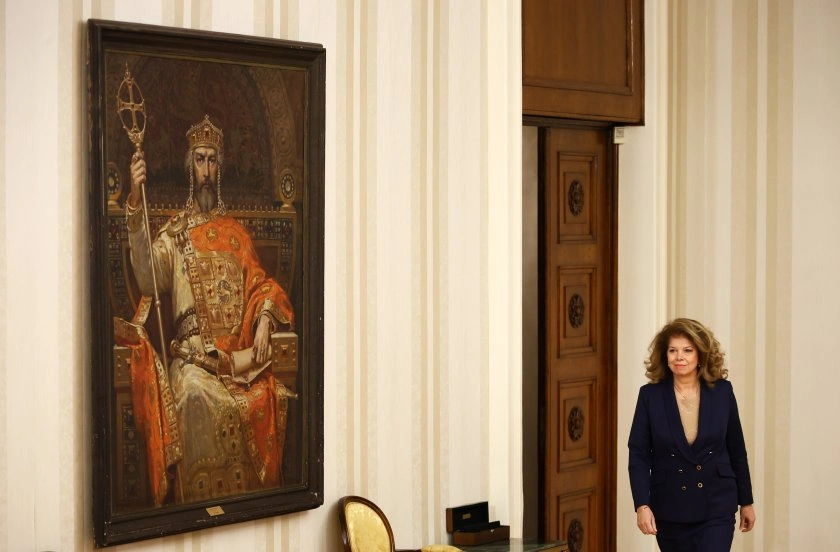

We are witnessing a historic milestone as Iliana Iotova officially became Bulgaria’s first female president on January 23, 2026. This groundbreaking development marks a significant moment in the nation’s political landscape, as she assumes the prestigious role of the first woman to hold this position in Bulgarian history.
Following the Constitutional Court’s ruling on the early termination of President Rumen Radev’s powers after his resignation submission, Vice President Iliana Iotova has stepped into the presidency. Notably, Radev is the only Bulgarian president to have left office before completing his term. As Bulgaria’s sixth head of state in the office’s 33-year history, Iliana Malinova Iotova now leads the nation through this unprecedented transition. Her ascension is not just a personal achievement but also a transformative moment for women in Bulgarian politics and leadership.
Iliana Iotova assumes presidency after Radev resignation
Bulgaria witnessed a dramatic political shift when President Rumen Radev formally tendered his resignation to the Constitutional Court on January 20, 2026. This unprecedented move in Bulgaria’s post-communist history set in motion a constitutional succession process that would ultimately place Vice President Iliana Malinova Iotova at the helm of the nation.
Constitutional Court rules on early termination
The Constitutional Court of Bulgaria acted swiftly after receiving Radev’s resignation. On January 23, 2026, the twelve judges unanimously approved the early termination of President Radev’s powers. The court’s decision was final and took immediate effect, marking a significant constitutional milestone as Radev became the first Bulgarian president to resign before completing his term. According to Article 97 of the Constitution, the court needed to establish whether the resignation “was submitted voluntarily, as a result of a freely formed will”—a condition they confirmed had been met in Radev’s case.
Vice President Iliana Iotova steps in as per Bulgarian Constitution
Immediately upon the court’s ruling, the constitutional mechanism for presidential succession activated. In accordance with Article 97(3) of the Bulgarian Constitution, Vice President Iliana Iotova automatically assumed the presidency for the remainder of the term, which expires in January 2027. As acting president, Iotova inherited substantial responsibilities during this politically tumultuous period. Her immediate constitutional duties include appointing a caretaker government and setting a date for early parliamentary elections. Additionally, she must select a caretaker prime minister from among ten senior state officials designated by the constitution. Reports suggest she may consider Andrey Gyurov, Deputy Governor of the Bulgarian National Bank, who is regarded as having limited connections to the GERB party and influential oligarch Delyan Peevski.
Public and political reactions to the transition
A formal farewell ceremony marked the transition of power at the presidency building in Sofia. At 4 pm on January 23, Iotova escorted Radev to the ceremonial entrance of the presidency building. Outside, scores of supporters gathered to greet the departing president, some holding Bulgaria’s red, green, and white national flag. The transition occurs amid significant political turbulence—recent anti-corruption protests forced the resignation of Prime Minister Rosen Zhelyazkov’s administration in December, highlighting the challenging political landscape Iotova now navigates as commander-in-chief. Moreover, while the presidency in Bulgaria is largely ceremonial, the role gains substantial importance during periods of political uncertainty and institutional deadlock. Consequently, Iotova now stands at the center of Bulgaria’s immediate political agenda, tasked with steering the nation through its current challenges.
Read other Articles – The Inspiring Journey of Mike Wolfe: From Antique Collector to TV Star
Iliana Iotova builds career from journalism to politics
Iliana Malinova Iotova’s professional journey began far from the presidential office, initially taking shape in the media landscape of post-Communist Bulgaria. Her path from journalism to becoming a key political figure demonstrates her versatility and commitment to public service.
Early work at Bulgarian National Television
From 1990 to 1997, Iliana Iotova established herself as one of the recognizable faces of Bulgarian National Television (BNT). Throughout this period, she served in multiple capacities – as a reporter, editor, presenter, and eventually rose to become the head of directorate of ‘News and Current Affairs Programs’. Her media career coincided with Bulgaria’s tumultuous transition to democracy, providing her with firsthand experience of the nation’s political transformation. Initially educated at the 9th French Language School in Sofia and later graduating with a degree in Bulgarian Philology from Sofia University “St. Kliment Ohridski,” Iotova further specialized in European studies at France’s National School of Administration in Strasbourg.
Role as BSP press center head during political crisis
In 1997, Iotova made a pivotal career change, transitioning from journalism to politics. She was personally invited by Georgi Parvanov, the new leader of the Bulgarian Socialist Party (BSP) who later served two terms as president. Subsequently, she headed the Press Office of the Supreme Council of the Bulgarian Socialist Party from 1997 to 2007. Regarding this career shift, she has stated, “I will always remain a leftist, and I will never forget who extended a hand to me or where I started”. Her decade-long tenure managing the party’s communications occurred during a particularly challenging political period for Bulgaria.
Election to National Assembly and early legislative work
In 2005, Iotova’s political career advanced significantly when she was elected to the 40th National Assembly of Bulgaria, a position she held until 2007. During her parliamentary tenure, she:
- Headed the Bulgarian delegation to the Assemblée parlementaire de la Francophonie
- Served as a member of the delegation to the Parliamentary Assembly of the Council of Europe
- Participated in the “triple coalition government” – a compromise between the BSP, the liberal DPS, and the “royal” NDSV party – formed to secure Bulgaria’s accession to the European Union
Concurrently, Iotova continued rising through BSP party ranks, becoming deputy chairman of the City Council of BSP-Sofia in January 2006, a position she maintained until 2012. Furthermore, in 2012, she was elected to the Executive Bureau of the National Assembly of the BSP, where she remained until 2016.
Iliana Iotova represents Bulgaria in European Parliament

Image Source: Wikimedia Commons – Wikimedia.org
In June 2007, Iliana Malinova Iotova embarked on a decade-long tenure in the European Parliament, representing Bulgaria within the Progressive Alliance of Socialists and Democrats group.
Key committee roles and legislative contributions
Throughout her three consecutive terms (2007-2017), Iotova held pivotal positions, including vice-chair of the Committee on Civil Liberties, Justice and Home Affairs. Her parliamentary career spanned numerous committees, including Internal Market and Consumer Protection, Fisheries, and Regional Development. Altogether, her work extended to specialized bodies such as the Committee on Organized Crime, Corruption and Money Laundering, where she served as deputy chair.
Focus on civil liberties, migration, and anti-corruption
Iotova primarily concentrated on crucial security and rights issues, becoming her parliamentary group’s rapporteur on equitable distribution of 40,000 refugees across EU member states. She authored significant legislative proposals tackling the migration crisis. Furthermore, Iotova advocated combining various EU monitoring mechanisms into a broader rule of law framework applicable across all member states.
Advocacy for Black Sea regional cooperation
Perhaps most notably, Iotova authored the European Parliament’s first report on the Black Sea and its fisheries. Her dedication to sustainable development in the Black Sea region remained a hallmark of her parliamentary work. Since joining the EU Parliament, Vice President Iotova consistently championed Bulgaria’s accession to the Schengen Area.
Read other Articles – What People Mean When They Say Coppa
Iliana Iotova leads with focus on education and diaspora

Image Source: БНР
Throughout her public service, Vice President Iliana Malinova Iotova has championed Bulgarian cultural preservation beyond national borders. Her presidency builds upon these foundational initiatives.
Support for Bulgarian Sunday schools abroad
Iotova has consistently emphasized that the system of Sunday schools represents “the most successful policy for Bulgarians abroad“. Throughout her tenure, she personally visited Bulgarian educational institutions across Europe, including five schools in Austria and the Bulgarian Sunday School in Barcelona.
“Bulgaria is everywhere where Bulgarian is spoken, where there are Bulgarian associations and Bulgarian schools that preserve and develop the Bulgarian language and culture,” Iotova declared during her Barcelona visit. Undoubtedly, she considers language preservation fundamental to maintaining Bulgarian identity, often encouraging parents: “Take time to tell your children about Bulgaria in Bulgarian”.
Campaigns against domestic violence and elder abuse
In addition to educational initiatives, Iotova has advocated for strengthening governmental institutions’ capacity-building activities, primarily focusing on combating domestic violence.
Foreign policy balancing EU, NATO, and non-Western ties
Despite international tensions, Iotova maintains diplomatic balance. In July 2022, she welcomed Ukrainian students of Bulgarian origin at the Presidency. During this meeting, she expressed hope that “reason will prevail and the voice of peace will be heard louder than weapons”. Iotova has likewise supported educational initiatives connecting Bulgarian diaspora communities with their ancestral homeland, as evidenced by her backing of university-led awareness programs.
Conclusion
Iliana Iotova’s historic ascension to the presidency represents a watershed moment for Bulgarian politics and women’s leadership. Throughout her remarkable career journey from journalism to the highest office in the land, she has consistently demonstrated her commitment to public service and democratic values. Bulgarian citizens now witness firsthand how her extensive experience across multiple sectors—media, national politics, and European diplomacy—has prepared her for this unprecedented role.
Her decade-long service in the European Parliament undoubtedly equipped her with valuable international perspectives, while her advocacy for Bulgarian Sunday schools abroad shows her dedication to preserving national identity beyond borders. Equally important, her campaigns against domestic violence reflect her commitment to social justice and human rights protection.
Bulgaria faces significant political challenges during this transition period. Nevertheless, Iotova’s balanced approach to foreign policy, coupled with her experience navigating complex political landscapes, positions her effectively to address these obstacles. Her leadership style, characterized by pragmatism and cultural preservation, emerges at a critical juncture when Bulgaria seeks stability amid political uncertainty.
Though the presidency traditionally holds ceremonial power, this unique moment in Bulgarian history grants Iotova substantial influence over the nation’s immediate political direction. Therefore, her precedent-setting administration not only breaks gender barriers but also arrives at a pivotal time when strong leadership is essential.
Ultimately, President Iotova’s journey from television journalist to head of state embodies Bulgaria’s own democratic evolution. As she assumes command of the armed forces and prepares to appoint a caretaker government, she carries both the weight of constitutional responsibility and the hopes of generations of Bulgarian women. Her presidency thus marks not merely a personal achievement but a transformative chapter in Bulgaria’s democratic development and gender equality progress.
FAQs
Q1. Who is Iliana Iotova and how did she become Bulgaria’s president? Iliana Iotova is Bulgaria’s first female president, assuming office on January 23, 2026, after President Rumen Radev’s resignation. As the former vice president, she stepped into the role according to the Bulgarian Constitution when Radev’s powers were terminated early.
Q2. What is Iliana Iotova’s professional background? Iotova began her career in journalism at Bulgarian National Television, later transitioning to politics. She served in the Bulgarian National Assembly, represented Bulgaria in the European Parliament for a decade, and held the position of vice president before becoming president.
Q3. What are some of Iliana Iotova’s key focus areas as a leader? Iotova has focused on supporting Bulgarian education abroad, particularly Sunday schools for the diaspora. She has also campaigned against domestic violence and elder abuse, and worked on balancing Bulgaria’s foreign policy between EU, NATO, and non-Western ties.
Q4. How significant is Iotova’s presidency for Bulgaria? Iotova’s presidency is historically significant as she is the first woman to hold this position in Bulgaria. Her ascension marks a milestone for women’s leadership in the country and comes at a crucial time of political transition, where her experience may prove valuable in navigating challenges.
Q5. What immediate responsibilities does Iotova face as the new president? As the new president, Iotova’s immediate responsibilities include appointing a caretaker government, setting a date for early parliamentary elections, and selecting a caretaker prime minister. She also assumes the role of commander-in-chief of the armed forces during a period of political uncertainty.
Interested in similar content or opportunities. Contact Us